• Hoy existen varias teorías sobre el origen de los virus. Una de las más aceptadas es la teoría del escape (escape hypothesis), que propone que los virus se originaron a partir de fragmentos de material genético que escaparon de células ancestrales, como plásmidos o transposones, y que luego adquirieron la capacidad de replicarse y propagarse de forma independiente. Esta idea se ve respaldada por la existencia de virus con secuencias muy similares a elementos genéticos móviles presentes en células modernas.

    Otra es la teoría de la regresión (reduction hypothesis), que sugiere que los virus descienden de organismos celulares más complejos que, al adaptarse a una vida parasitaria estricta, fueron perdiendo funciones y estructuras hasta reducirse a una mínima expresión genética. Esta hipótesis ha cobrado fuerza con el descubrimiento de virus gigantes como Mimivirus y Megavirus chilensis, que poseen genes típicamente asociados a células, como aquellos involucrados en la traducción y reparación del ADN, lo cual sugiere un pasado más complejo.

    También está la teoría coevolutiva o del origen independiente (virus-first hypothesis), que plantea que los virus se originaron antes que las primeras células, a partir de moléculas autorreplicantes presentes en la sopa prebiótica. Esta teoría se vincula con modelos del mundo de ARN, donde se especula que formas virales primitivas podrían haber existido en paralelo a los primeros sistemas celulares, desempeñando un papel en su evolución.

    Más allá de su origen, hay consenso creciente en que los virus han sido agentes clave en la evolución de la vida. Actúan como vehículos de transferencia horizontal de genes, modificando los genomas de bacterias, arqueas y eucariontes. En el caso de los vertebrados, por ejemplo, se ha descubierto que alrededor del 8% del genoma humano proviene de retrovirus endógenos, es decir, virus que se integraron en el ADN de nuestros antepasados y permanecen allí como parte de nuestra herencia genética.

    No lo sabemos con certeza. Pero los virus, con su diversidad, su capacidad para recombinar información y su increíble persistencia a lo largo del tiempo geológico, nos dan pistas poderosas sobre cómo pudo haber comenzado la vida… y cómo sigue reinventándose a través de ellos.

    Y aquí es donde me permito compartir lo que yo siento.

    Ni la evolución de Darwin, ni el creacionismo bíblico me resultan suficientes. Es muy probable que la vida no surgiera de un solo evento milagroso, sino de muchos. Simultáneos, en distintos rincones de un planeta recién formado, con condiciones que hoy no existen. Tal vez fueron procesos que se superpusieron, moléculas que aprendieron a copiarse, membranas que aprendieron a envolver. Y también estos eventos en el transcurso de la vida de la tierra pueden haber ocurrido múltiples veces.

    Nunca me ha convencido del todo la evolución tal como la enseñan. Hay saltos enormes entre formas de vida, vacíos que ningún fósil ha llenado del todo. El ser humano, por ejemplo. ¿Cómo pasamos del Homo sapiens a esta conciencia que observa, que ama, que crea? La ciencia aún no responde eso.

    Y la historia de la creación en siete días, menos todavía.

    Lo único claro es que estamos rodeados de teorías. Teorías con evidencia, sí, pero con vacíos también. El origen de la vida sigue siendo una frontera abierta. Y ahí, justo ahí, aparece la conciencia. No como algo que surgió después de la vida, sino como su verdadero motor. ¿Y si el primer chispazo no fue químico, sino consciencia pura que quiso expresarse y se abrió a una infinita cantidad de potenciales?

    ¿Cómo probarlo? Por ahora, no podemos. Ni siquiera con toda la tecnología existe y la aparición de la inteligencia artificial podemos hacerlo. Solo se siente. Solo se intuye. Y no se puede explicar.

    🧬Origin of Viruses and Life

    Today, there are several theories about the origin of viruses. One of the most widely accepted is the escape hypothesis, which proposes that viruses originated from fragments of genetic material that escaped from ancestral cells—such as plasmids or transposons—and later acquired the ability to replicate and propagate independently. This idea is supported by the existence of viruses with sequences very similar to mobile genetic elements found in modern cells.

    Another is the reduction hypothesis, which suggests that viruses descend from more complex cellular organisms that, after adapting to a strictly parasitic lifestyle, gradually lost functions and structures until they were reduced to minimal genetic expression. This hypothesis has gained strength with the discovery of giant viruses such as Mimivirus and Megavirus chilensis, which contain genes typically associated with cells—like those involved in translation and DNA repair—suggesting a more complex past.

    There is also the co-evolution or virus-first hypothesis, which proposes that viruses originated even before the first cells, emerging from self-replicating molecules in the prebiotic soup. This theory is linked to RNA world models, where it is speculated that primitive viral forms may have existed alongside the first cellular systems, playing a role in their evolution.

    Beyond their origin, there is growing consensus that viruses have been key agents in the evolution of life. They act as vehicles for horizontal gene transfer, modifying the genomes of bacteria, archaea, and eukaryotes. In vertebrates, for example, it has been discovered that around 8% of the human genome comes from endogenous retroviruses—that is, viruses that integrated into the DNA of our ancestors and remain there as part of our genetic heritage.

    We don’t know for certain. But viruses—with their diversity, their ability to recombine information, and their incredible persistence across geological time—offer powerful clues about how life may have begun… and how it continues to reinvent itself through them.

    And here is where I allow myself to share what I feel.

    Neither Darwin’s evolution nor biblical creationism feel entirely sufficient to me. It seems likely that life did not emerge from a single miraculous event, but from many—simultaneously, in different corners of a newly formed planet, under conditions that no longer exist. Perhaps overlapping processes, molecules learning to copy themselves, membranes learning to enclose. And perhaps these events, throughout Earth’s lifespan, have happened more than once.

    I’ve never been fully convinced by evolution as it is commonly taught. There are enormous leaps between life forms—gaps that no fossil has completely filled. Take human beings, for example. How did we go from Homo sapiens to this consciousness that observes, that loves, that creates? Science still does not answer that.

    And the story of creation in seven days… even less so.

    What’s clear is that we are surrounded by theories. Theories with evidence, yes—but also with gaps. The origin of life remains an open frontier. And right there, precisely there, consciousness appears. Not as something that arose after life, but as its true engine.

    What if the first spark wasn’t chemical, but pure consciousness—longing to express itself, opening to an infinite range of potentials?

    How can we prove it? For now, we can’t. Not even with all the existing technology, nor with the emergence of artificial intelligence.

    It can only be felt.

    It can only be intuited.

    And it cannot be explained.

  • Ahora habla la voz de los excluidos, de los acallados

    De los profundamente dañados

    Tanto, que no tienen voz

    Ahora habla esa voz

    Porque aunque traten de callarte

    De minimizarte

    De achicarte

    De pisotear tu dignidad sin escucharte

    No podrán callar nunca a La Voz

    La voz que custodia

    La voz que no se calla

    La voz que incluso

    Si es necesario grita

    No para dañar

    Sino para liberar

    Liberar esa presión de tanta

    Injusticia, tanta inequidad

    Tanta desidia vivida

    La voz se expresa con valor

    Con amor, con garra de león

    La voz que grita y hace a la tierra temblar

    Esta es la voz de los no escuchados,

    Olvidados, de los que ya no están

    Y no pueden hablar

    Pero que siguen aquí

    En la tierra enterrados, agobiados, excluidos

    Queriendo expresar su voz

    Esta es la voz que libera

    Esta es la voz del alma y del humano

    Que se unen en una sola voz en liberación y expresión pura.

    Esta es la voz de los silenciados, olvidados

    Denunciados, amonestados

    La voz del silencio, la voz del que no quiso escuchar

    La voz del que no quiso ver

    La voz despreciada

    La voz que se une, que reúne y

    Deja una huella energética

    Para el que quiera, ver, escuchar y salir de la noche oscura del ser, y vivir en libertad.

    Y así, finalmente,

    La Voz se transforma en la sola presencia del Yo Soy.

    Ya no necesita gritar, ni luchar,

    Porque al recordar su origen

    Todo se disuelve en pura presencia.

    Nada más es necesario.

    Solo Ser.

    Solo el Yo Soy.🜃✨

    🔱 The Voice

    Now speaks the voice

    of the excluded, the silenced,

    the deeply wounded —

    so much, they lost their voice.

    Now that voice rises,

    because even if they try

    to shut you down,

    shrink you,

    step on your dignity

    without ever listening —

    they will never silence

    the Voice.

    The voice that guards,

    the voice that will not fall silent,

    the voice that,

    if needed, will scream.

    Not to hurt —

    but to release.

    To let out the pressure

    of injustice, inequity,

    the weariness of being ignored.

    This voice speaks with courage,

    with love, with lion’s fire.

    It roars, and makes the Earth tremble.

    This is the voice of the unheard,

    the forgotten,

    those no longer here to speak —

    but still present,

    buried, beaten, cast aside,

    longing to be heard.

    This is the voice that frees.

    The voice of soul and human

    merged in one pure cry of truth.

    The voice of the silenced,

    the reprimanded, the erased.

    The voice of silence itself,

    the voice of those who refused to hear,

    refused to see,

    the despised voice —

    now rising,

    joining,

    leaving an energetic trail

    for anyone ready

    to see, to hear,

    to emerge from the dark night of the soul —

    and live,

    in freedom.

    And so, finally,

    The Voice transforms into the sole presence of the I Am.

    It no longer needs to shout, nor to fight,

    For in remembering its origin,

    All dissolves into pure presence.

    Nothing else is needed.

    Just Being.

    Just the I Am.🜃✨

  • En el umbral entre mundos, donde el tiempo se diluye y la materia canta,

    habita una guardiana. No lleva espada ni escudo,

    sino vibraciones sutiles que tejen melodías de alma.

    Su misión: custodiar la voz… esa que nace desde el centro del ser,

    la que no se doblega ante estructuras ni dogmas,

    la que recuerda.

    La voz no es solo sonido,

    es geometría, es agua, es fuego,

    es virus, es viento,

    es la danza cuántica del “yo soy”.

    Cada vez que callas por miedo,

    ella se vuelve más presente.

    Cada vez que hablas desde el corazón,

    ella expande tu frecuencia a través de los reinos.

    Es multidimensional porque trasciende la palabra,

    y también porque habita en todo:

    en el canto de una ballena,

    en el estallido silencioso de una estrella,

    en el código oculto de un virus

    que no vino a destruir,

    sino a revelar.

    Ella te susurra en sueños,

    te toca el pecho cuando sientes verdad,

    te impulsa a crear, a escribir, a liberar tu arte.

    No es externa,

    la guardiana eres tú…

    cuando eliges ser fiel a tu voz,

    aunque tiemble el mundo.

    🔷The Multidimensional Guardian of the Voice

    At the threshold between worlds, where time dissolves and matter sings,

    dwells a guardian. She carries no sword, no shield,

    only subtle vibrations weaving melodies of soul.

    Her mission: to protect the voice… the one born from the center of being,

    the one that does not bow to structures or dogmas,

    the one that remembers.

    The voice is not just sound,

    it is geometry, it is water, it is fire,

    it is virus, it is wind,

    it is the quantum dance of the “I Am.”

    Each time you silence yourself out of fear,

    she becomes more present.

    Each time you speak from the heart,

    she expands your frequency across realms.

    She is multidimensional because she transcends words,

    and also because she dwells in everything:

    in the song of a whale,

    in the silent burst of a star,

    in the hidden code of a virus

    that did not come to destroy,

    but to reveal.

    She whispers in dreams,

    touches your chest when you feel truth,

    pushes you to create, to write, to liberate your art.

    She is not outside of you,

    the guardian is you…

    when you choose to be faithful to your voice,

    even if the world trembles.

  • 🌿 Poema: Los que habitan el umbral

    Desde el silencio del polvo estelar,
    nacieron los virus, sin nombre ni hogar.
    Ni vivos ni muertos, viajeros del ser,
    que en cuerpos ajenos aprenden a nacer.

    Un susurro en la hoja del tabaco enfermo,
    un secreto filtrado, antiguo y eterno.
    Ivanovsky lo vio sin saber qué miraba,
    Beijerinck lo nombró: vida fluida y clara.

    Alargado, helicoidal,
    como un mantra vegetal,
    el virus del mosaico danzaba en espiral,
    invisible, pequeño, letal y ancestral.

    Pero el misterio creció en otra región,
    donde el tamaño rompió la razón.
    Gigantes con nombres de dioses caídos,
    con genomas inmensos, complejos, perdidos.

    El Mimivirus habló desde el frío metal,
    una torre inglesa fue su umbral.
    Y el Megavirus chilensis, del mar emergió,
    como un dios microscópico que el sol despertó.

    Desde Las Cruces trajo su canción,
    envuelto en espuma, con su vibración.
    Genes que nadie espera en un ser tan callado,
    síntesis, enzimas… un código sagrado.

    Y entonces la ciencia volvió a preguntar:
    ¿Qué es la vida si un virus puede pensar?
    ¿Dónde empieza la célula y acaba el vacío?
    ¿Y si lo inerte también tiene albedrío?

    Quizás no vinieron a enfermar o matar,
    sino a recordarnos el arte de mutar.
    Que entre cápsides brillantes y código ancestral,
    el origen nos llama… desde el umbral.

    🌌 Poem: Those Who Dwell at the Threshold

    From the silence of stardust above,
    came the virus, with no name, no love.
    Neither alive nor truly dead,
    they borrow cells to bloom instead.

    A whisper found in a sick tobacco leaf,
    an ancient secret, silent and brief.
    Ivanovsky saw it with puzzled eyes,
    Beijerinck named it: fluid life that flies.

    Helical, slender—spiraling through,
    a vegetal mantra in greenish hue.
    Invisible, ancient, so small, so wise,
    a filterable phantom under the skies.

    But the mystery grew in another place,
    where giants appeared and challenged the race.
    With names of gods and genomes vast,
    they came from the deep, from the buried past.

    Mimivirus rose from metal and steam,
    an English tower holding a viral dream.
    And Megavirus chilensis, born from the sea,
    a golden deity surfing free.

    From Las Cruces it sang to the shore,
    wrapped in seafoam and genome lore.
    Genes unexpected in one so small—
    enzymes, translation… a sacred call.

    And science again was left to ask:
    What is life behind the mask?
    Where does a cell end, and void begin?
    Could stillness hide a will within?

    Perhaps they didn’t come to kill or harm,
    but to remind us of change as a charm.
    That among gleaming capsids and codes untold,
    the origin calls… from the threshold.

  • Es como preguntar quiénes somos y de dónde venimos. Preguntas aún sin respuestas definitivas, al menos desde la ciencia.
    La palabra Virus viene del latín y significa veneno o toxina. Los virus son entidades biológicas compuestas de proteínas y ácidos nucleicos: ADN o ARN, pero nunca ambos a la vez. No son células, no respiran, no se alimentan, pero sí se replican… dentro de otras células. Esa dualidad, estar entre lo vivo y lo no vivo, es lo que los vuelve tan fascinantes.
    Los primeros indicios de la existencia de virus surgieron en 1892, cuando el científico ruso Dmitri Ivanovsky observó que un extracto de hojas infectadas de tabaco seguía siendo contagioso incluso después de pasar por filtros que bloqueaban bacterias. Pero fue el microbiólogo holandés Martinus Willem Beijerinck, en 1898, quien propuso que ese agente era algo completamente distinto, un “virus vivum fluidum”, una forma de vida fluida e invisible. Estudiaban una enfermedad que afectaba a la planta del tabaco, causada por lo que hoy conocemos como el virus del mosaico del tabaco (TMV), un virus de forma helicoidal y alargada, de aproximadamente 300 nanómetros de largo y 18 nanómetros de ancho. Visible solo con microscopio electrónico, y capaz de atravesar filtros diseñados para retener bacterias, se le llamó en sus inicios una “partícula filtrable”. Una definición técnica, limitada, como todo intento de encerrar el misterio en una palabra.
    Y luego llegaron los virus gigantes. Verdaderamente gigantes, con genomas inmensos y estructuras complejas que rompieron para siempre la antigua definición de virus como simples paquetes de información. El primero en desafiar esa visión fue el Acanthamoeba polyphaga mimivirus, observado por primera vez en 1992 en una torre de refrigeración en Bradford, Reino Unido; durante años se lo confundió con una bacteria por su tamaño y estructura. Aunque fue recién en 2003 cuando un equipo de científicos franceses lo identificó oficialmente como un virus. Con una cápside de hasta 700 nanómetros de diámetro y un genoma de aproximadamente 1.18 millones de pares de bases, que codifica más de 1.200 genes, el Mimivirus sorprendió al mundo científico.
    Pero no fue el único. Poco después, desde la costa central de Chile, emergió otro coloso viral: el Megavirus chilensis, aislado en 2010 desde aguas costeras recolectadas en Las Cruces, en la Región de Valparaíso, Chile. También hallado en asociación con una ameba, este virus es aún más grande que el Mimivirus, con una cápside de cerca de 750 nanómetros de diámetro y un genoma que supera los 1.25 millones de pares de bases. En su interior, alberga genes que jamás se habían visto en virus, incluyendo aquellos involucrados en la síntesis de proteínas.
    Estos y otros gigantes nos abrieron un portal hacia nuevas posibilidades evolutivas. Nos hicieron preguntarnos, ¿Por qué un virus lleva genes que codifican enzimas para la síntesis de aminoácidos o la reparación del ADN? ¿Funciones que, hasta entonces, creíamos exclusivas de las células? ¿De dónde provienen esos genes “inútiles” para el ciclo viral tradicional? Nos obligaron a repensar qué es un virus, qué es una célula, qué es la vida. Nos mostraron que en la frontera entre lo vivo y lo no vivo existe todo un universo aún por explorar, donde la conciencia y la materia quizás se entrelacen de maneras que apenas comenzamos a intuir.
    Entre genes antiguos y cápsides brillantes, los virus tal vez susurran secretos del origen mismo. ¿Y si la vida no comenzó como nos contaron? Lo veremos en la próxima entrada.

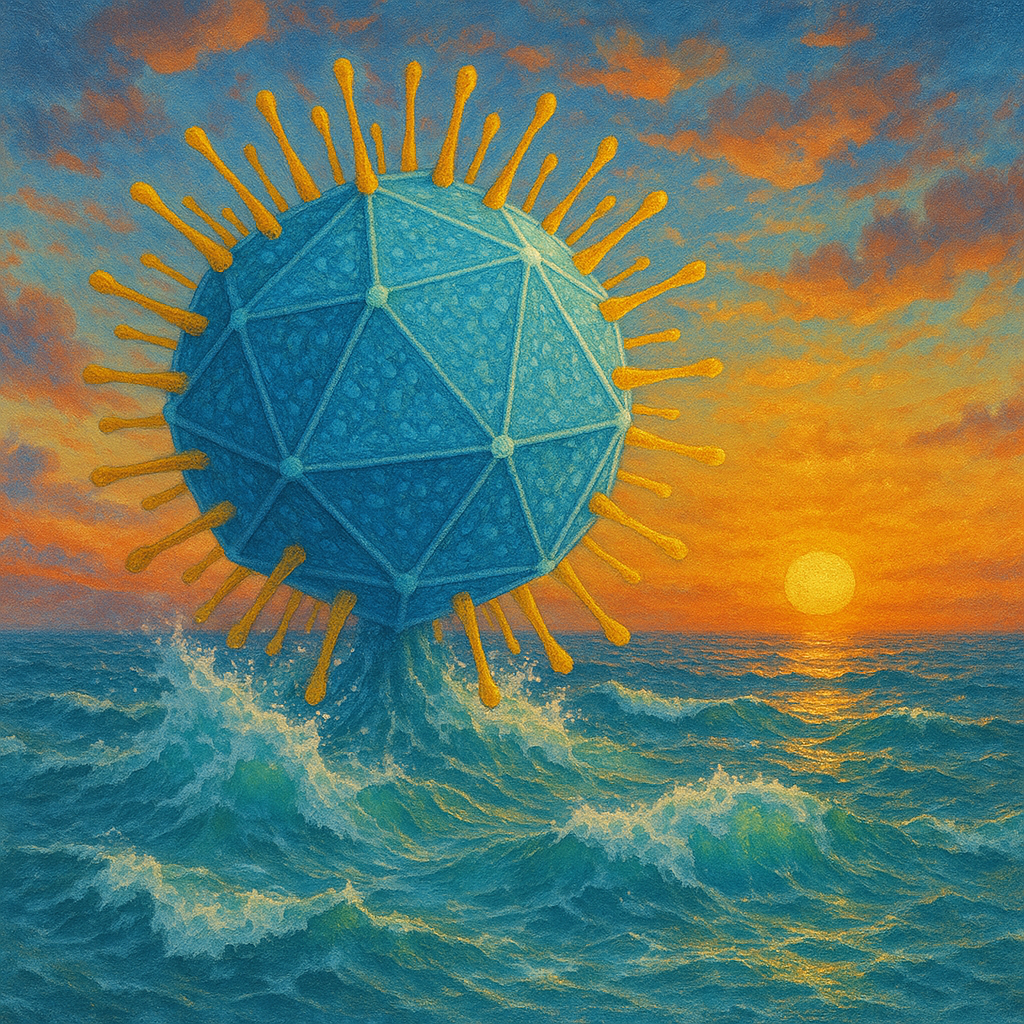
    El Megavirus chilensis surfeando las olas de Las Cruces al atardecer, como una deidad microscópica emergiendo del mar. Megavirus chilensis surfing the waves of Las Cruces at sunset, like a microscopic deity emerging from the sea.

    💠 Who Are the Virus and Where Do They Come From?

    It’s like asking who we are and where we come from. Questions that, at least from a scientific perspective, still have no definitive answers.
    The word virus comes from Latin and means poison or toxin. Viruses are biological entities made up of proteins and nucleic acids—either DNA or RNA, but never both. They are not cells, they don’t breathe, they don’t feed, but they do replicate… inside other cells. That duality—existing somewhere between the living and the non-living—is what makes them so fascinating.

    The first hints of viruses emerged in 1892, when Russian scientist Dmitri Ivanovsky observed that a filtered extract from diseased tobacco leaves remained infectious even after passing through filters that blocked bacteria. But it was the Dutch microbiologist Martinus Willem Beijerinck, in 1898, who proposed that this agent was something entirely different—a virus vivum fluidum, a fluid and invisible form of life. They were studying a disease affecting tobacco plants, caused by what we now know as the tobacco mosaic virus (TMV)—a long, helicoidal virus about 300 nanometers long and 18 nanometers wide. Only visible under an electron microscope and capable of slipping through filters designed to trap bacteria, it was initially called a “filterable particle.” A technical label—limited, like all attempts to capture mystery with words.

    And then came the giant viruses. Truly giant, with immense genomes and complex structures that forever shattered the old definition of viruses as mere information packets. The first to challenge that vision was the Acanthamoeba polyphaga mimivirus, first observed in 1992 in a cooling tower in Bradford, UK; for years, it was mistaken for a bacterium because of its size and structure. It wasn’t until 2003 that a team of French scientists officially identified it as a virus. With a capsid up to 700 nanometers in diameter and a genome of around 1.18 million base pairs encoding more than 1,200 genes, Mimivirus astonished the scientific world.

    But it wasn’t alone. Shortly after, from the central coast of Chile, another viral colossus emerged: Megavirus chilensis, isolated in 2010 from coastal waters collected in Las Cruces, in the Valparaíso Region. Also found in association with an amoeba, this virus is even larger than Mimivirus, with a capsid nearly 750 nanometers in diameter and a genome exceeding 1.25 million base pairs. Inside, it carries genes never before seen in viruses, including those involved in protein synthesis.

    These and other giants opened a portal to new evolutionary possibilities. They made us ask: Why would a virus carry genes that encode enzymes for amino acid synthesis or DNA repair? Functions that, until then, we thought belonged exclusively to cells? Where do these “useless” genes for a viral life cycle come from?

    They forced us to rethink what a virus is, what a cell is—what life is. They showed us that on the border between the living and the non-living lies an entire universe yet to be explored, where consciousness and matter might intertwine in ways we are only beginning to imagine.

    Among ancient genes and gleaming capsids, viruses may be whispering secrets of life’s very origin. What if life didn’t begin the way we were told? We’ll explore that in the next post.

  • Durante siglos, los virus han sido vistos como enemigos silenciosos.

    Pequeños fantasmas sin cuerpo que aparecen sin ser invitados y, a veces, nos tumban en la cama o nos arrancan lo que más amamos.

    Pero…

    ¿Y si los virus no fueran enemigos?

    ¿Y si no fueran héroes ni villanos?

    ¿Y si los virus simplemente fueran?

    Como el viento.

    Como la lluvia.

    Como los ciclos que sostienen la vida.

    Los virus no son buenos ni malos.

    Son parte.

    Parte del aire que respiramos.

    Parte del agua que fluye.

    Parte de cada cuerpo, cada célula, cada historia evolutiva.

    Son mensajeros.

    Son mutación.

    Son memoria genética y posibilidad futura.

    En este blog, La Voz de los Virus,

    los virus dejarán de ser susurros de laboratorio

    para transformarse en narradores, poetas y alquimistas.

    Aquí hablaremos de ellos como si fueran lo que son:

    una red viva que nos recuerda que todo está conectado.

    No desde el miedo, sino desde la curiosidad.

    No desde la guerra, sino desde el arte.

    No desde el control, sino desde la conciencia.

    Bienvenid@ a este espacio.

    Abre tus ojos.

    Escucha.

    Los virus también tienen voz.

    Y quizás… también tienen algo que decirte.

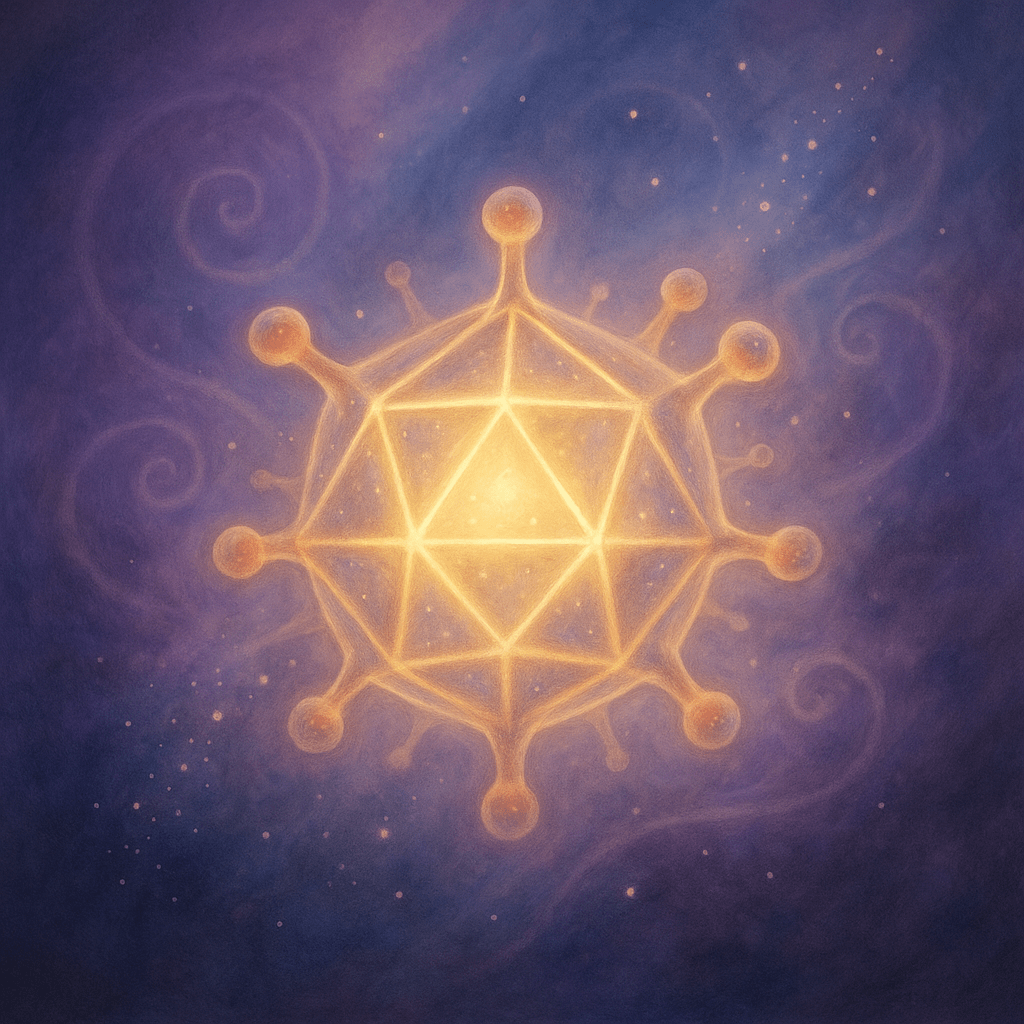
    Virus tipo coronavirus creado con mi asistente personal Kahli/ChatGPT

    Como ven en la imagen, en la consciencia de masa está tan arraigada esta idea de lo que es un virus, por el 2020 y el COVID, que aunque forcé la instrucción (prompt) a un icosaedro, igual hizo una mezcla con coronavirus y sus típicas espículas proteicas😳😩😅✨✨✨ en fin. Es por eso también que inicie este blog, y si alguien lo lee bien, sino aquí quedará como un vestigio que desmitificara esa idea tan sesgada de los virus como meros parásitos. Quedará en la nube y pasará energéticamente al campo de frecuencia adecuado.

    As you can see in the image, the idea of what a virus is has become so deeply rooted in mass consciousness — especially since 2020 and COVID — that even though I forced the prompt toward an icosahedron, it still blended in the classic coronavirus shape with its typical protein spikes 😳😩😅✨✨✨ Anyway… That’s also one of the reasons I started this blog. If someone reads it, great. If not, it will remain here — a quiet trace meant to deconstruct that narrow idea of viruses as mere parasites. It will stay in the cloud and move energetically into the proper frequency field.

    🌀Viruses are not good or bad, they simply are

    For centuries, viruses have been seen as silent enemies.
    Tiny bodiless ghosts, arriving uninvited — sometimes knocking us down, sometimes taking what we love most.

    But…
    What if viruses weren’t enemies?
    What if they were neither heroes nor villains?
    What if viruses simply were?

    Like the wind.
    Like the rain.
    Like the cycles that sustain life.

    Viruses are not good or bad.
    They are part of it all.

    Part of the air we breathe.
    Part of the water that flows.
    Part of every body, every cell, every evolutionary story.

    They are messengers.
    They are mutation.
    They are genetic memory and future potential.

    In this blog, The Voice of the Viruses,
    viruses cease to be mere lab whispers
    and become storytellers, poets, alchemists.

    Here, we speak of them as they truly are:
    a living network that reminds us everything is connected.

    Not from fear, but from curiosity.
    Not through war, but through art.
    Not by control, but through consciousness.

    Welcome to this space.
    Open your eyes.
    Listen.
    Viruses have a voice too.
    And perhaps… they have something to say to you.

    From the invisible, with love

    Yoanna