Durante mucho tiempo hemos observado a los ecosistemas como escenarios donde las especies simplemente habitan, compiten, crecen o desaparecen. Sin embargo, cuando se los mira con más atención, emerge otra posibilidad: la de entenderlos como sistemas capaces de integrar múltiples señales, reorganizarse frente al cambio y sostener, hasta donde les es posible, una cierta coherencia interna. No se trata de atribuirles pensamiento en un sentido humano, sino de reconocer que en la trama de la vida existe una forma de inteligencia distribuida, relacional y dinámica.
Un ecosistema responde. Ajusta sus flujos, reorganiza sus interacciones, modifica sus equilibrios. A veces resiste. A veces se transforma. A veces persiste solo en apariencia, mientras en sus capas más profundas ya ha comenzado otra historia. La resiliencia, en este contexto, no siempre significa retorno. Muchas veces significa adaptación, reconfiguración o desplazamiento hacia un nuevo estado.
Chile ofrece múltiples ejemplos de estas tensiones. En sus ríos, lagos, fiordos y bosques se inscriben huellas de introducciones biológicas que no surgieron necesariamente desde la malicia, sino desde decisiones humanas que alguna vez parecieron razonables, útiles o inocuas. Castores, salmones, conejos, ratas, avispas, didymo y tantos otros organismos forman parte de una historia más amplia: la de una especie que interviene los territorios con una intensidad que pocas veces alcanza a comprender por completo. Me refiero a la especie humana, claro está.
Tal vez la especie más invasora de todas no sea otra que el propio ser humano. No porque invada solo con violencia, sino también porque transforma por ambición, por descuido, por desconocimiento o incluso por el deseo de mejorar lo que toca. En ese gesto hay una paradoja profundamente humana: intervenir sin alcanzar a ver del todo la complejidad de las relaciones que ya estaban ahí, sosteniendo silenciosamente la vida.
Frente a ello, los ecosistemas no permanecen inmóviles. Absorben, amortiguan, responden, colapsan o se reorganizan. Y en ese proceso dejan señales. Algunas son visibles en el paisaje; otras aparecen en la composición de las comunidades, en las redes tróficas, en la calidad del agua o en la pérdida de ciertas especies. Pero muchas de las señales más finas permanecen ocultas a simple vista. Habitan el mundo microscópico.
Ahí es donde los virus pueden comenzar a hablarnos de otra manera.
Lejos de ser solo entidades asociadas a enfermedad, los virus también forman parte de la arquitectura íntima de los ecosistemas. Acompañan a sus hospederos, responden a cambios ambientales, modulan poblaciones microbianas, participan en la circulación de materia y energía, y reflejan alteraciones que muchas veces aún no se expresan en escalas mayores. Son diminutos, pero no marginales. Son invisibles, pero no irrelevantes.
Observar a los virus en un ecosistema es, en cierto modo, escuchar una capa profunda de su memoria y de su transformación. Allí donde una invasión biológica altera una red de interacciones, donde una perturbación antrópica modifica las condiciones del sistema, o donde una comunidad comienza a reorganizarse en silencio, los virus pueden registrar esa historia en tiempo real. No como testigos neutrales, sino como participantes activos de la dinámica ecológica.
Quizás por eso vale la pena cambiar la pregunta. No solo preguntarnos qué especies llegaron, qué especies se fueron o qué impacto inmediato produjo una introducción, sino también qué nuevas relaciones emergieron, qué equilibrios se rompieron, qué señales tempranas de cambio quedaron inscritas en las tramas invisibles del sistema. Y en esa búsqueda, los virus podrían convertirse en uno de los lenguajes más sensibles para leer la resiliencia, la fragilidad y la capacidad de adaptación de los ecosistemas.
Porque la vida no solo se expresa en lo que vemos. También se organiza en lo diminuto, en lo relacional, en aquello que parece secundario hasta que comprendemos que allí se sostiene gran parte de la historia.
Tal vez la inteligencia de un ecosistema consista precisamente en eso: en su capacidad de integrar perturbación y memoria, cambio y continuidad, pérdida y reorganización. Y tal vez los virus, desde su escala mínima, tengan mucho que enseñarnos sobre esa inteligencia que no habla con palabras, pero sí con patrones, vínculos y transformaciones.
Escucharlos mejor podría ayudarnos no solo a entender los ecosistemas que hemos alterado, sino también a repensar nuestro lugar dentro de ellos.
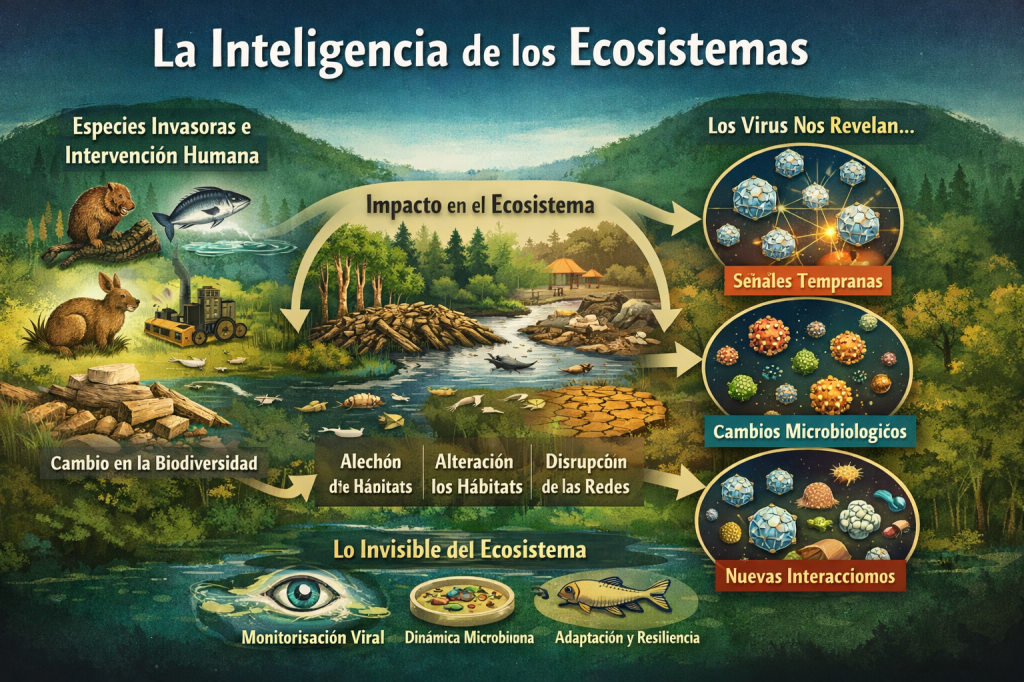
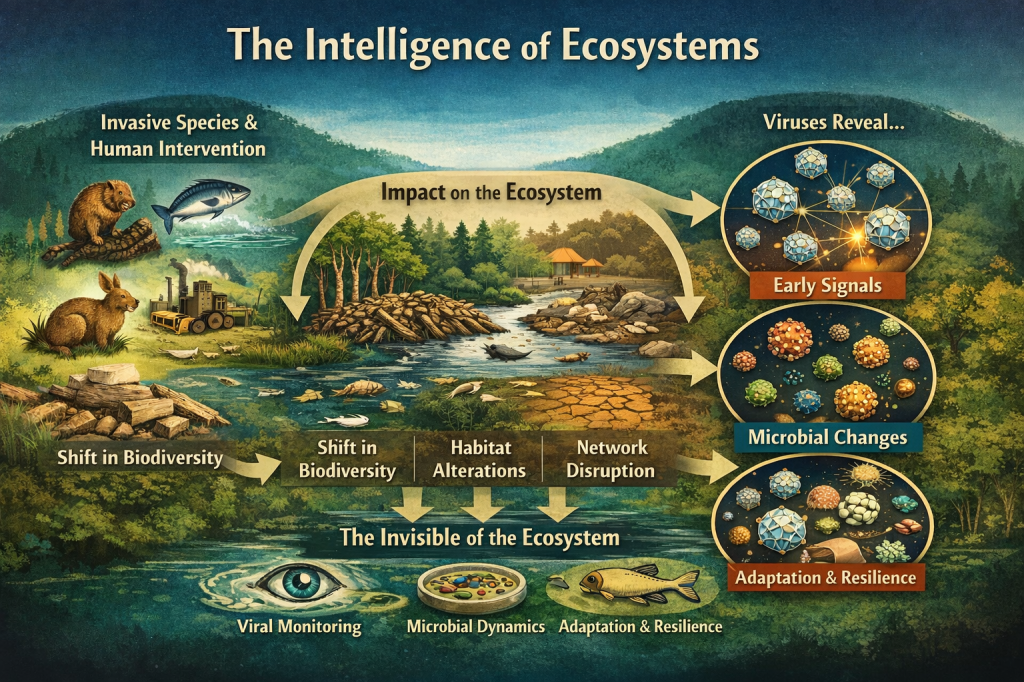
Infogramas creados con ChatGPT
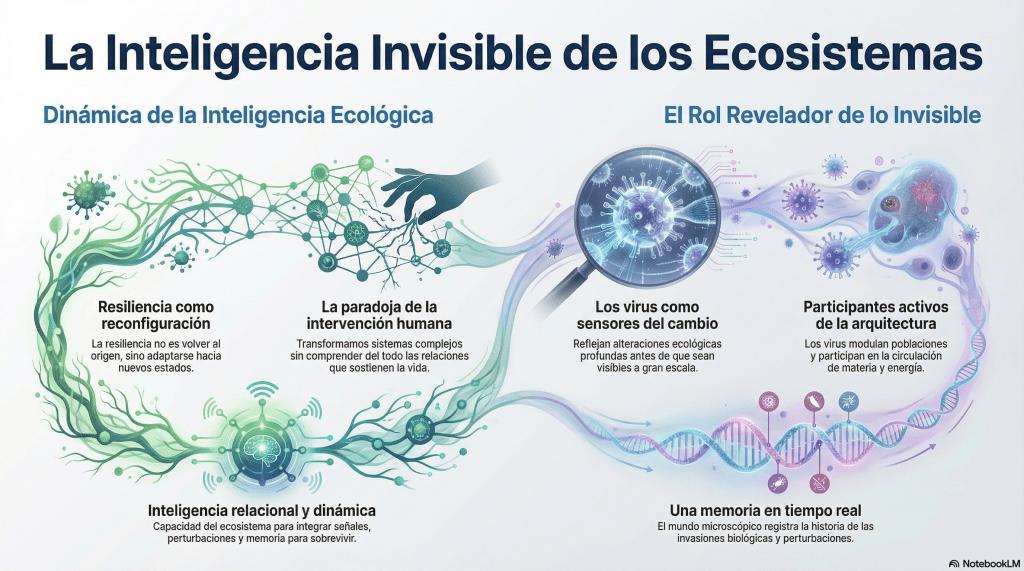
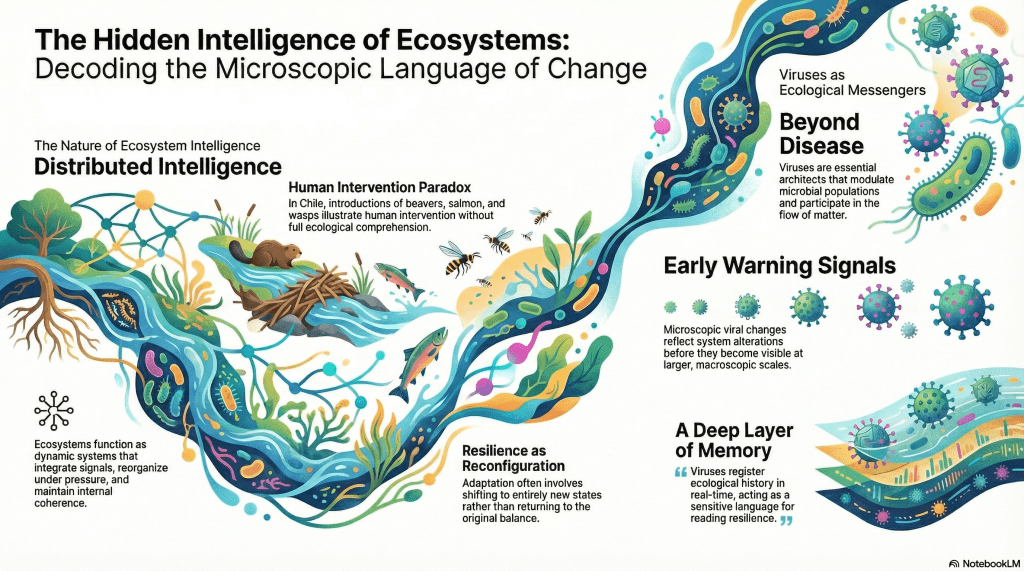
Infogramas creados con NotebookLM
ENGLISH VERSION
🐟🦫🦟🦠The Intelligence of the Ecosystems
For a long time, we have observed ecosystems as stages where species simply inhabit, compete, grow, or disappear. However, when examined more closely, another possibility emerges: understanding them as systems capable of integrating multiple signals, reorganizing in response to change, and maintaining—within their limits—a certain internal coherence. This is not about attributing human-like thought to ecosystems, but rather recognizing that within the fabric of life there exists a form of distributed, relational, and dynamic intelligence.
An ecosystem responds. It adjusts its flows, reorganizes its interactions, and modifies its balances. Sometimes it resists. Sometimes it transforms. Sometimes it persists only in appearance, while in its deeper layers another story has already begun. In this context, resilience does not always mean return. Often, it means adaptation, reconfiguration, or a shift toward a new state.
Chile offers multiple examples of these tensions. In its rivers, lakes, fjords, and forests, one can trace the marks of biological introductions that did not necessarily arise from malice, but from human decisions that once seemed reasonable, useful, or harmless. Beavers, salmon, rabbits, rats, wasps, didymo, and many other organisms are part of a broader story: that of a species that intervenes in territories with an intensity it rarely fully understands. The species, of course, is our own.
Perhaps the most invasive species of all is the human being. Not only because it invades through force, but also because it transforms through ambition, carelessness, lack of knowledge, or even the desire to improve what it touches. Within this gesture lies a deeply human paradox: intervening without fully perceiving the complexity of the relationships that were already there, quietly sustaining life.
In response, ecosystems do not remain still. They absorb, buffer, respond, collapse, or reorganize. And in this process, they leave signals. Some are visible in the landscape; others appear in community composition, trophic networks, water quality, or the loss of certain species. Yet many of the most sensitive signals remain hidden from plain sight. They inhabit the microscopic world.
This is where viruses begin to speak in a different way.
Far from being merely entities associated with disease, viruses are also part of the intimate architecture of ecosystems. They accompany their hosts, respond to environmental changes, modulate microbial populations, participate in the circulation of matter and energy, and reflect alterations that often have not yet manifested at larger scales. They are small, but not marginal. Invisible, but not irrelevant.
Observing viruses within an ecosystem is, in a sense, listening to a deep layer of its memory and transformation. Wherever a biological invasion alters a network of interactions, where anthropogenic disturbance modifies system conditions, or where a community begins to reorganize in silence, viruses may record that history in real time. Not as neutral witnesses, but as active participants in ecological dynamics.
For this reason, it may be worth changing the question. Not only asking which species arrived, which species disappeared, or what immediate impact an introduction produced, but also what new relationships emerged, which balances were disrupted, and what early signals of change became inscribed in the invisible fabric of the system. In this search, viruses may become one of the most sensitive languages for reading ecosystem resilience, fragility, and adaptive capacity.
Because life is not expressed only in what we see. It is also organized in the small, in the relational, in what appears secondary until we realize that much of the story is sustained there.
Perhaps the intelligence of an ecosystem lies precisely in this capacity: to integrate disturbance and memory, change and continuity, loss and reorganization. And perhaps viruses, from their minimal scale, have much to teach us about this intelligence—one that does not speak with words, but with patterns, connections, and transformations.
Listening more carefully to them may help us not only understand the ecosystems we have altered, but also rethink our place within them.


Deja un comentario