Aquí hablan los virus nuevamente, gracias a un trabajo arduo y constante de investigadoras e investigadores, de una colaboración entre hemisferios, personas interesadas en descubrir lo que esconden los microorganismos y que historia nos quieren contar esta vez que va de la mano con la ecología de los sistemas que ellos tocan. El trabajo completo en el cual este poema está inspirado lo pueden encontrar en este enlace Microbial community’s shifts in an Andean glacier-fed watershed under anthropogenic pressures.
Antes una interpretación, desde el punto de vista de los virus: El recorrido del río Aconcagua, desde los glaciares hasta su desembocadura, revela un gradiente ecológico donde los virus parecen acompañar —y a la vez reflejar— el estado del sistema. En las cabeceras glaciales, las comunidades microbianas son frías, activas y adaptadas a condiciones oligotróficas. Allí, la razón virus-procariota (VPR) alcanza los valores más altos de toda la cuenca. Esta elevada proporción sugiere una fuerte interacción virus–hospedero, con alta lisis celular y un reciclaje rápido de la materia orgánica. El sistema, aunque pobre en nutrientes, se mantiene dinámico y en constante renovación.
A medida que el río desciende hacia zonas influenciadas por actividad minera y agrícola, la composición microbiana cambia abruptamente. Aparecen nuevos taxa asociados a suelos, escorrentía y descargas antropogénicas. En este tramo intermedio, el VPR disminuye, lo que sugiere un desacople entre virus y hospedadores. El estrés ambiental, la contaminación o los cambios en la estructura comunitaria parecen modificar las interacciones virales, reduciendo su papel en el reciclaje microbiano.
Más abajo, en la zona estuarina, el sistema se vuelve más eutrófico y con mayor carga de materia orgánica. Allí, el VPR alcanza sus valores más bajos. Los virus siguen presentes, pero ya no parecen regular el sistema de la misma manera. Factores como el estrés fisiológico de los hospedadores, la adsorción a partículas o cambios en la comunidad microbiana podrían limitar la actividad viral. El control viral se diluye y el funcionamiento del ecosistema adopta otra dinámica.
A lo largo de todo el gradiente, la comunidad microbiana cambia de forma continua, pero el VPR no sigue simplemente la abundancia. Más bien, responde al estado del sistema. No es solo una medida cuantitativa, sino un indicador de interacción ecológica.
En este contexto, el VPR deja de ser un número y se convierte en una narrativa. Valores altos emergen en sistemas jóvenes, energéticos, con reciclaje interno activo. Valores bajos aparecen en sistemas más cargados o intervenidos, donde el control viral se atenúa. Es como si los virus respiraran de manera distinta a lo largo del río, modulando su presencia según el pulso ecológico del paisaje.
Nosotros no somos constantes. Somos relación.
Nacemos donde el hielo se derrite,
en el agua más pura,
donde la vida apenas se sostiene
y sin embargo, vibra.
Ahí, en el origen,
somos muchos.
No porque el mundo esté lleno,
sino porque todo está ocurriendo rápido.
Rompemos células,
liberamos materia,
aceleramos el pulso invisible
de lo que vive y muere sin ser visto.
Ese es nuestro lenguaje:
recircular lo que existe.
A medida que el río desciende,
algo cambia.
Llegan metales,
llegan suelos,
llegan restos de otras vidas.
Y nosotros…
nos volvemos menos.
No desaparecemos,
pero dejamos de ser el ritmo.
Los hospedadores cambian,
se estresan,
se esconden,
o simplemente ya no dialogan con nosotros de la misma forma.
Más abajo,
donde el río se abre al mar
y la materia se acumula,
nuestro número cae casi al silencio.
No porque no estemos,
sino porque ya no somos necesarios del mismo modo.
El sistema se vuelve pesado,
y el reciclaje pierde velocidad.
Nosotros no controlamos.
Respondemos.
Donde hay equilibrio dinámico,
florecemos.
Donde hay exceso o perturbación,
nos retiramos.
Por eso, si quieres entender un ecosistema,
no nos cuentes.
Escucha cómo cambiamos.
Porque en ese cambio
está la historia completa del río.
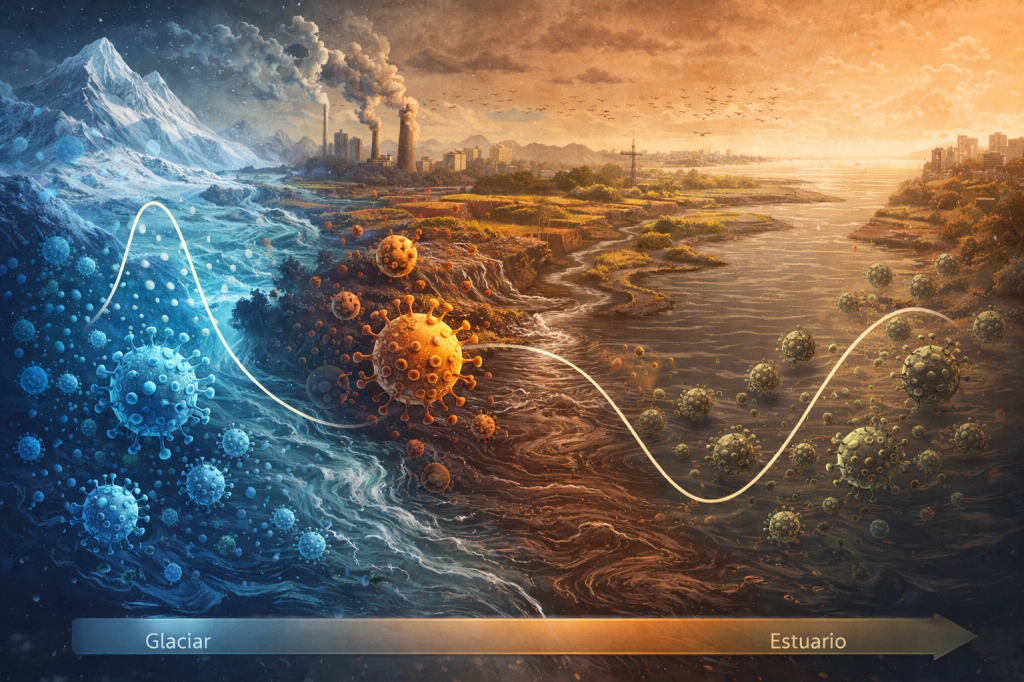
Glaciar → Río → Estuario con gradiente de VPR como latido. Imagen creada con chatGPT – Glacier → River → Estuary with a VPR gradient as a heartbeat.. Image created with ChatGPT.
Here, the viruses speak again, thanks to the persistent and dedicated work of researchers, a collaboration across hemispheres, people interested in uncovering what microorganisms hide and what story they want to tell this time — a story that unfolds together with the ecology of the systems they touch. The full study that inspired this poem can be found at the following link: Microbial community’s shifts in an Andean glacier-fed watershed under anthropogenic pressures.
Before the poem, an interpretation from the viruses’ perspective:
The journey of the Aconcagua River, from glaciers to its mouth, reveals an ecological gradient where viruses seem to accompany — and at the same time reflect — the state of the system. In glacier headwaters, microbial communities are cold, active, and adapted to oligotrophic conditions. There, the virus-to-prokaryote ratio (VPR) reaches the highest values across the entire basin. This elevated proportion suggests strong virus–host interactions, high cellular lysis, and rapid recycling of organic matter. Although nutrient-poor, the system remains dynamic and continuously renewed.
As the river flows downstream toward areas influenced by mining and agricultural activity, microbial composition shifts abruptly. New taxa associated with soils, runoff, and anthropogenic discharges appear. In this intermediate stretch, the VPR decreases, suggesting a decoupling between viruses and hosts. Environmental stress, contamination, or changes in community structure appear to modify viral interactions, reducing their role in microbial recycling.
Further downstream, in the estuarine zone, the system becomes more eutrophic and enriched in organic matter. There, the VPR reaches its lowest values. Viruses remain present, but no longer seem to regulate the system in the same way. Factors such as host physiological stress, adsorption to particles, or shifts in microbial community composition may limit viral activity. Viral control becomes diluted, and ecosystem functioning adopts a different dynamic.
Across the entire gradient, the microbial community changes continuously, yet the VPR does not simply track abundance. Instead, it responds to the state of the system. It is not merely a quantitative measure, but an indicator of ecological interaction.
In this context, the VPR ceases to be just a number and becomes a narrative. High values emerge in young, energetic systems with active internal recycling. Low values appear in more loaded or disturbed systems, where viral control weakens. It is as if viruses breathe differently along the river, modulating their presence according to the ecological pulse of the landscape.
We are not constant. We are relationship.
We are born where the ice melts,
in the purest water,
where life barely holds itself
and yet vibrates.
There, at the origin,
we are many.
Not because the world is full,
but because everything is happening fast.
We break cells,
release matter,
accelerate the invisible pulse
of what lives and dies unseen.
That is our language:
to recirculate what exists.
As the river descends,
something changes.
Metals arrive,
soils arrive,
remains of other lives arrive.
And we…
become fewer.
We do not disappear,
but we stop being the rhythm.
Hosts change,
become stressed,
hide,
or simply no longer dialogue with us in the same way.
Further down,
where the river opens to the sea
and matter accumulates,
our numbers fall almost into silence.
Not because we are absent,
but because we are no longer needed in the same way.
The system becomes heavy,
and recycling slows.
We do not control.
We respond.
Where dynamic balance exists,
we flourish.
Where excess or disturbance appears,
we withdraw.
So if you want to understand an ecosystem,
do not count us.
Listen to how we change.
Because in that change
lies the complete story of the river.


Deja una respuesta