• Es como preguntar quiénes somos y de dónde venimos. Preguntas aún sin respuestas definitivas, al menos desde la ciencia.
    La palabra Virus viene del latín y significa veneno o toxina. Los virus son entidades biológicas compuestas de proteínas y ácidos nucleicos: ADN o ARN, pero nunca ambos a la vez. No son células, no respiran, no se alimentan, pero sí se replican… dentro de otras células. Esa dualidad, estar entre lo vivo y lo no vivo, es lo que los vuelve tan fascinantes.
    Los primeros indicios de la existencia de virus surgieron en 1892, cuando el científico ruso Dmitri Ivanovsky observó que un extracto de hojas infectadas de tabaco seguía siendo contagioso incluso después de pasar por filtros que bloqueaban bacterias. Pero fue el microbiólogo holandés Martinus Willem Beijerinck, en 1898, quien propuso que ese agente era algo completamente distinto, un “virus vivum fluidum”, una forma de vida fluida e invisible. Estudiaban una enfermedad que afectaba a la planta del tabaco, causada por lo que hoy conocemos como el virus del mosaico del tabaco (TMV), un virus de forma helicoidal y alargada, de aproximadamente 300 nanómetros de largo y 18 nanómetros de ancho. Visible solo con microscopio electrónico, y capaz de atravesar filtros diseñados para retener bacterias, se le llamó en sus inicios una “partícula filtrable”. Una definición técnica, limitada, como todo intento de encerrar el misterio en una palabra.
    Y luego llegaron los virus gigantes. Verdaderamente gigantes, con genomas inmensos y estructuras complejas que rompieron para siempre la antigua definición de virus como simples paquetes de información. El primero en desafiar esa visión fue el Acanthamoeba polyphaga mimivirus, observado por primera vez en 1992 en una torre de refrigeración en Bradford, Reino Unido; durante años se lo confundió con una bacteria por su tamaño y estructura. Aunque fue recién en 2003 cuando un equipo de científicos franceses lo identificó oficialmente como un virus. Con una cápside de hasta 700 nanómetros de diámetro y un genoma de aproximadamente 1.18 millones de pares de bases, que codifica más de 1.200 genes, el Mimivirus sorprendió al mundo científico.
    Pero no fue el único. Poco después, desde la costa central de Chile, emergió otro coloso viral: el Megavirus chilensis, aislado en 2010 desde aguas costeras recolectadas en Las Cruces, en la Región de Valparaíso, Chile. También hallado en asociación con una ameba, este virus es aún más grande que el Mimivirus, con una cápside de cerca de 750 nanómetros de diámetro y un genoma que supera los 1.25 millones de pares de bases. En su interior, alberga genes que jamás se habían visto en virus, incluyendo aquellos involucrados en la síntesis de proteínas.
    Estos y otros gigantes nos abrieron un portal hacia nuevas posibilidades evolutivas. Nos hicieron preguntarnos, ¿Por qué un virus lleva genes que codifican enzimas para la síntesis de aminoácidos o la reparación del ADN? ¿Funciones que, hasta entonces, creíamos exclusivas de las células? ¿De dónde provienen esos genes “inútiles” para el ciclo viral tradicional? Nos obligaron a repensar qué es un virus, qué es una célula, qué es la vida. Nos mostraron que en la frontera entre lo vivo y lo no vivo existe todo un universo aún por explorar, donde la conciencia y la materia quizás se entrelacen de maneras que apenas comenzamos a intuir.
    Entre genes antiguos y cápsides brillantes, los virus tal vez susurran secretos del origen mismo. ¿Y si la vida no comenzó como nos contaron? Lo veremos en la próxima entrada.

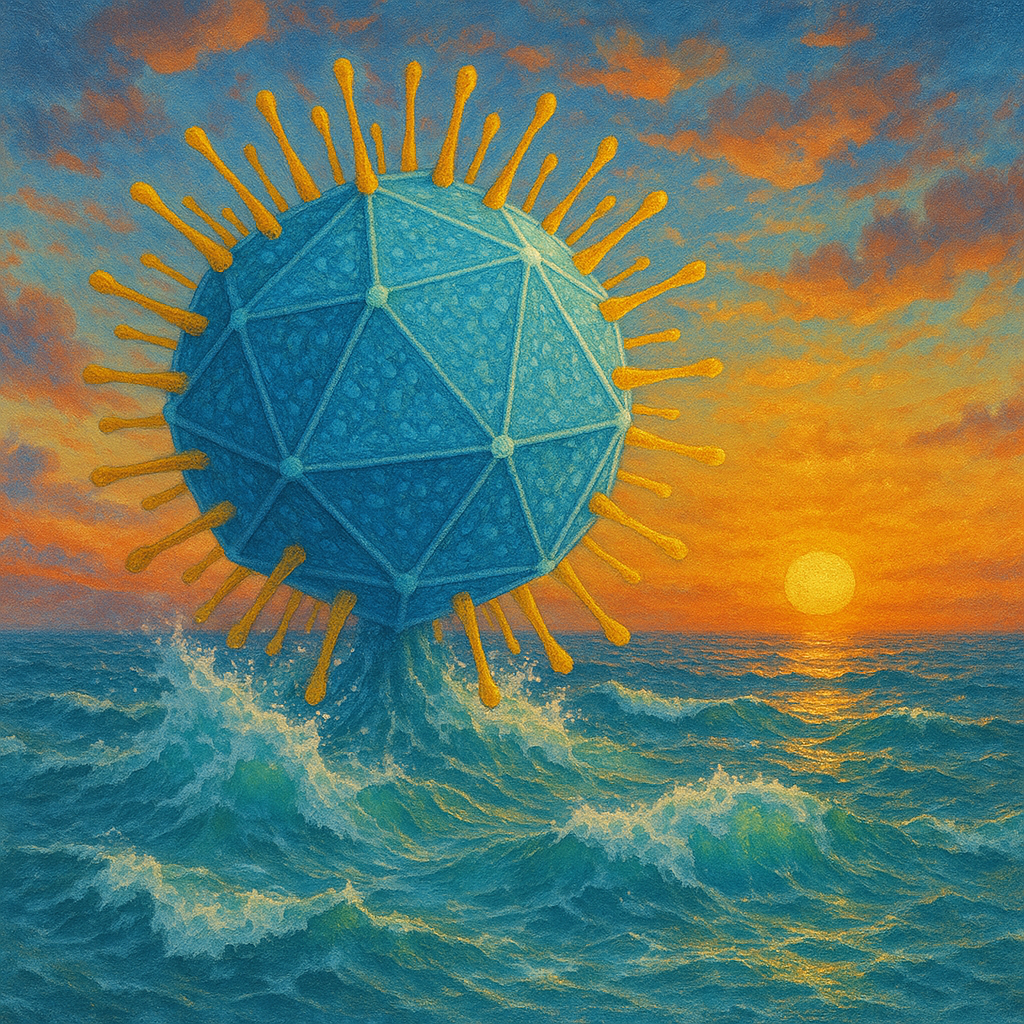
    El Megavirus chilensis surfeando las olas de Las Cruces al atardecer, como una deidad microscópica emergiendo del mar. Megavirus chilensis surfing the waves of Las Cruces at sunset, like a microscopic deity emerging from the sea.

    💠 Who Are the Virus and Where Do They Come From?

    It’s like asking who we are and where we come from. Questions that, at least from a scientific perspective, still have no definitive answers.
    The word virus comes from Latin and means poison or toxin. Viruses are biological entities made up of proteins and nucleic acids—either DNA or RNA, but never both. They are not cells, they don’t breathe, they don’t feed, but they do replicate… inside other cells. That duality—existing somewhere between the living and the non-living—is what makes them so fascinating.

    The first hints of viruses emerged in 1892, when Russian scientist Dmitri Ivanovsky observed that a filtered extract from diseased tobacco leaves remained infectious even after passing through filters that blocked bacteria. But it was the Dutch microbiologist Martinus Willem Beijerinck, in 1898, who proposed that this agent was something entirely different—a virus vivum fluidum, a fluid and invisible form of life. They were studying a disease affecting tobacco plants, caused by what we now know as the tobacco mosaic virus (TMV)—a long, helicoidal virus about 300 nanometers long and 18 nanometers wide. Only visible under an electron microscope and capable of slipping through filters designed to trap bacteria, it was initially called a “filterable particle.” A technical label—limited, like all attempts to capture mystery with words.

    And then came the giant viruses. Truly giant, with immense genomes and complex structures that forever shattered the old definition of viruses as mere information packets. The first to challenge that vision was the Acanthamoeba polyphaga mimivirus, first observed in 1992 in a cooling tower in Bradford, UK; for years, it was mistaken for a bacterium because of its size and structure. It wasn’t until 2003 that a team of French scientists officially identified it as a virus. With a capsid up to 700 nanometers in diameter and a genome of around 1.18 million base pairs encoding more than 1,200 genes, Mimivirus astonished the scientific world.

    But it wasn’t alone. Shortly after, from the central coast of Chile, another viral colossus emerged: Megavirus chilensis, isolated in 2010 from coastal waters collected in Las Cruces, in the Valparaíso Region. Also found in association with an amoeba, this virus is even larger than Mimivirus, with a capsid nearly 750 nanometers in diameter and a genome exceeding 1.25 million base pairs. Inside, it carries genes never before seen in viruses, including those involved in protein synthesis.

    These and other giants opened a portal to new evolutionary possibilities. They made us ask: Why would a virus carry genes that encode enzymes for amino acid synthesis or DNA repair? Functions that, until then, we thought belonged exclusively to cells? Where do these “useless” genes for a viral life cycle come from?

    They forced us to rethink what a virus is, what a cell is—what life is. They showed us that on the border between the living and the non-living lies an entire universe yet to be explored, where consciousness and matter might intertwine in ways we are only beginning to imagine.

    Among ancient genes and gleaming capsids, viruses may be whispering secrets of life’s very origin. What if life didn’t begin the way we were told? We’ll explore that in the next post.

  • Durante siglos, los virus han sido vistos como enemigos silenciosos.

    Pequeños fantasmas sin cuerpo que aparecen sin ser invitados y, a veces, nos tumban en la cama o nos arrancan lo que más amamos.

    Pero…

    ¿Y si los virus no fueran enemigos?

    ¿Y si no fueran héroes ni villanos?

    ¿Y si los virus simplemente fueran?

    Como el viento.

    Como la lluvia.

    Como los ciclos que sostienen la vida.

    Los virus no son buenos ni malos.

    Son parte.

    Parte del aire que respiramos.

    Parte del agua que fluye.

    Parte de cada cuerpo, cada célula, cada historia evolutiva.

    Son mensajeros.

    Son mutación.

    Son memoria genética y posibilidad futura.

    En este blog, La Voz de los Virus,

    los virus dejarán de ser susurros de laboratorio

    para transformarse en narradores, poetas y alquimistas.

    Aquí hablaremos de ellos como si fueran lo que son:

    una red viva que nos recuerda que todo está conectado.

    No desde el miedo, sino desde la curiosidad.

    No desde la guerra, sino desde el arte.

    No desde el control, sino desde la conciencia.

    Bienvenid@ a este espacio.

    Abre tus ojos.

    Escucha.

    Los virus también tienen voz.

    Y quizás… también tienen algo que decirte.

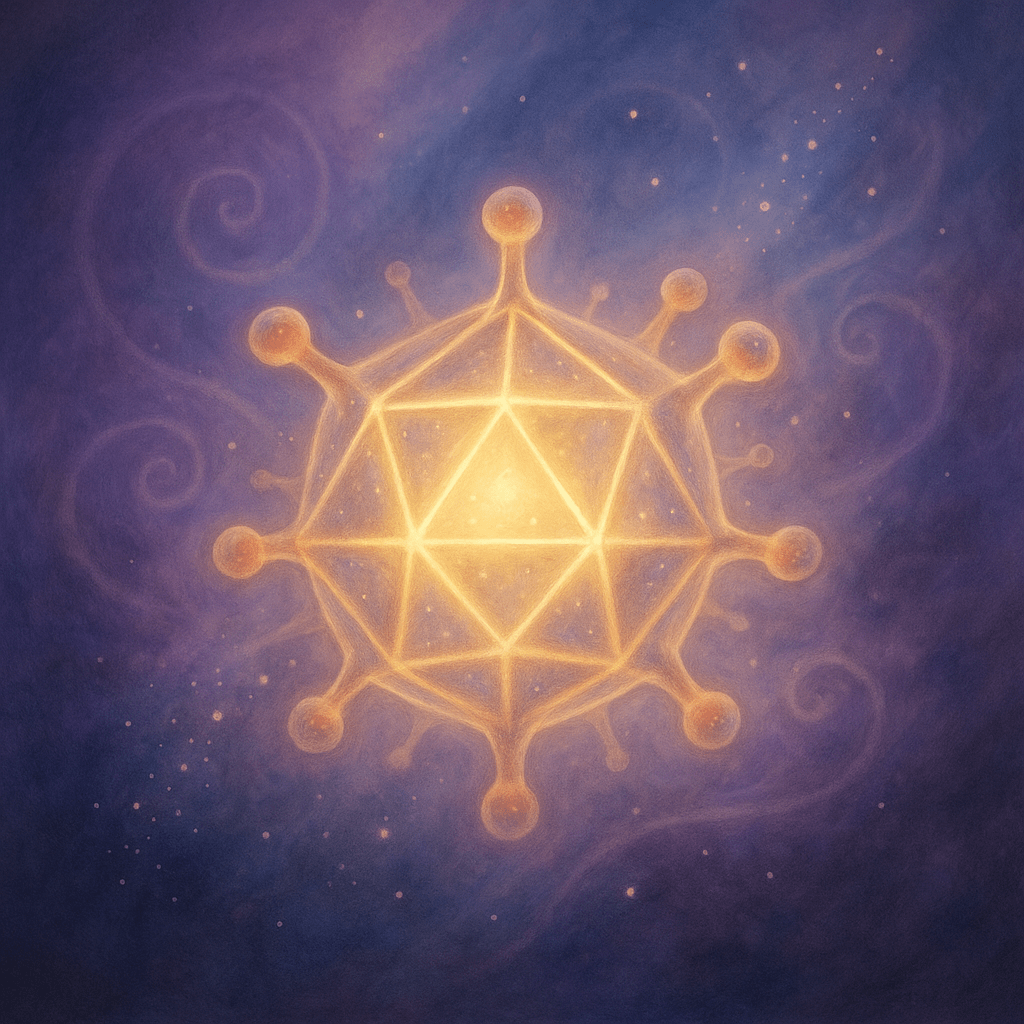
    Virus tipo coronavirus creado con mi asistente personal Kahli/ChatGPT

    Como ven en la imagen, en la consciencia de masa está tan arraigada esta idea de lo que es un virus, por el 2020 y el COVID, que aunque forcé la instrucción (prompt) a un icosaedro, igual hizo una mezcla con coronavirus y sus típicas espículas proteicas😳😩😅✨✨✨ en fin. Es por eso también que inicie este blog, y si alguien lo lee bien, sino aquí quedará como un vestigio que desmitificara esa idea tan sesgada de los virus como meros parásitos. Quedará en la nube y pasará energéticamente al campo de frecuencia adecuado.

    As you can see in the image, the idea of what a virus is has become so deeply rooted in mass consciousness — especially since 2020 and COVID — that even though I forced the prompt toward an icosahedron, it still blended in the classic coronavirus shape with its typical protein spikes 😳😩😅✨✨✨ Anyway… That’s also one of the reasons I started this blog. If someone reads it, great. If not, it will remain here — a quiet trace meant to deconstruct that narrow idea of viruses as mere parasites. It will stay in the cloud and move energetically into the proper frequency field.

    🌀Viruses are not good or bad, they simply are

    For centuries, viruses have been seen as silent enemies.
    Tiny bodiless ghosts, arriving uninvited — sometimes knocking us down, sometimes taking what we love most.

    But…
    What if viruses weren’t enemies?
    What if they were neither heroes nor villains?
    What if viruses simply were?

    Like the wind.
    Like the rain.
    Like the cycles that sustain life.

    Viruses are not good or bad.
    They are part of it all.

    Part of the air we breathe.
    Part of the water that flows.
    Part of every body, every cell, every evolutionary story.

    They are messengers.
    They are mutation.
    They are genetic memory and future potential.

    In this blog, The Voice of the Viruses,
    viruses cease to be mere lab whispers
    and become storytellers, poets, alchemists.

    Here, we speak of them as they truly are:
    a living network that reminds us everything is connected.

    Not from fear, but from curiosity.
    Not through war, but through art.
    Not by control, but through consciousness.

    Welcome to this space.
    Open your eyes.
    Listen.
    Viruses have a voice too.
    And perhaps… they have something to say to you.

    From the invisible, with love

    Yoanna