En las aguas más puras del planeta late un corazón diminuto.
Un pulso rosado y casi invisible: el krill, esa sinfonía microscópica que alimenta ballenas, pingüinos, focas y aves.
Cada uno de sus movimientos sostiene la vida. Cada descenso hacia la oscuridad arrastra carbono hacia el fondo del océano, activando una de las funciones más elegantes del planeta: la bomba biológica del carbono.
Pero ese corazón está siendo robado.
Hoy, mientras el hielo retrocede y el océano se calienta, una flota de barcos factoría arrastra sus redes en la península antártica.
Dicen que capturan “solo el 1 % del krill disponible”, basándose en estudios del año 2000.
Dos décadas de cambio climático no han sido consideradas, y esa cifra, aparentemente pequeña, se concentra justo en los lugares donde las ballenas y los pingüinos van a alimentarse.
La cuota “sostenible” se alcanzó antes de tiempo este año, en agosto 2025.
El mar quedó sin su pulso y la temporada de pesca debió cerrarse anticipadamente.
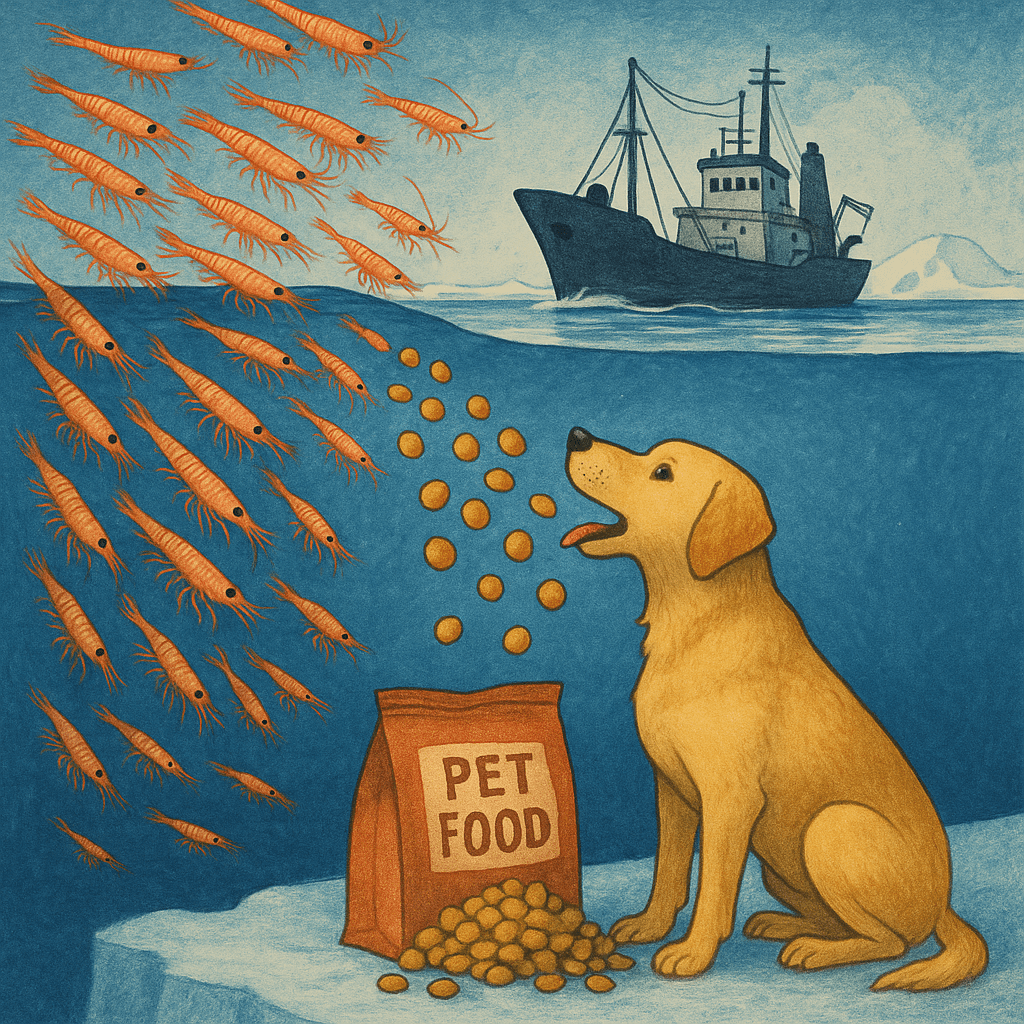
Y lo más absurdo: ese krill, base de la vida antártica, termina en cápsulas de omega-3 y en bolsas de alimento “premium” para mascotas.
La ironía de un sistema que llama “nutrición consciente” y al mismo tiempo despoja de alimento a los gigantes del sur.
Nos dicen que es puro, saludable, “sostenible”.
Pero el océano no conoce esas palabras: solo siente la ausencia.
En clase, cuando explico la bomba biológica, hablo de ese flujo invisible que conecta la superficie con la profundidad.
El krill, junto al fitoplancton y a los virus, forma parte del sistema respiratorio del planeta.
Cuando un virus infecta a una microalga y la hace estallar, el carbono se recicla: eso es el viral shunt, o desvío viral, una forma de equilibrio natural que evita el colapso.
El virus devuelve al mar lo que el sistema necesita.
El ser humano, en cambio, extrae sin devolver.
Así, bajo el disfraz de la ciencia aplicada y la economía azul, estamos desmantelando la maquinaria más perfecta de secuestro de carbono que existe.
El krill no solo alimenta; regula el clima global.
Su desaparición es una herida directa al ciclo del carbono, un latido menos en el corazón de Gaia.
Hoy el océano no necesita nuestra culpa, sino nuestra conciencia.
Observar sin odio, pero con lucidez.
Decir con calma: esto no está bien.
Y recordar que la vida no se sostiene desde la cima de la cadena trófica, sino desde sus raíces invisibles.
El krill, los virus, el fitoplancton, los verdaderos guardianes del equilibrio, no piden adoración, solo respeto.
🌬️ Mientras las ballenas 🐋 buscan alimento en aguas vaciadas, el ser humano presume de nutrición consciente.
Tal vez sea hora de devolver el pulso al corazón del océano.
🧊 The Theft of the Antarctic Heart: When Krill Becomes a Luxury Treat
In the purest waters on Earth beats a tiny heart —
a pink, almost invisible pulse: krill, the microscopic symphony that feeds whales, penguins, seals, and seabirds.
Each of its movements sustains life.
Each descent into the deep carries carbon to the ocean floor, activating one of the planet’s most elegant functions: the biological carbon pump.
But that heart is being stolen.
Today, as the ice retreats and the ocean warms, industrial trawlers drag their nets across the Antarctic Peninsula.
They claim to harvest “only 1% of the available krill,” relying on biomass estimates from the year 2000.
Two decades of climate change left unaccounted for.
And that seemingly small percentage is taken precisely where whales and penguins feed.
The “sustainable” quota was reached ahead of schedule this year, August 2025.
The sea was left without its pulse, and the fishing season had to close early.
And the most absurd part: this krill, the base of Antarctic life, ends up in omega-3 capsules and ‘premium’ pet food bags.
The irony of a system that calls itself “conscious nutrition” while starving the giants of the South.
We are told it is pure, healthy, “sustainable.”
But the ocean does not know those words, it only feels the absence.
In my classes, when I explain the biological pump, I speak of that invisible flow connecting the surface and the deep.
Krill, along with phytoplankton and viruses, form part of the planet’s respiratory system.
When a virus infects a microalga and bursts it open, carbon is recycled, this is the viral shunt, a natural mechanism of balance that prevents collapse.
The virus gives back to the sea what the system needs.
Humans, on the other hand, extract without returning.
Thus, under the mask of “blue economy” and “applied science,” we are dismantling the most perfect carbon-sequestration engine ever created.
Krill doesn’t just feed life, it regulates the planet’s climate.
Its disappearance is a direct wound to the carbon cycle, one less heartbeat in Gaia’s oceanic heart.
Today, the ocean doesn’t need our guilt, it needs our consciousness.
To observe without hatred, but with clarity.
To calmly say: this is not right.
And to remember that life is not sustained from the top of the food chain, but from its invisible roots.
Krill, viruses, phytoplankton, the true guardians of equilibrium, ask for no worship, only respect.
🌬️ While whales 🐋 search for food in emptied waters, humanity boasts of conscious nutrition.
Perhaps it’s time to give the ocean’s heart its pulse back.

 la voz de los virus
Deja un comentario