En el Salar de Huasco, a casi 4.000 metros de altura, la vida late al ritmo del sol. Cada día, bacterias, arqueas, algas… y también los virus enfrentan la radiación extrema que golpea este ecosistema frágil.
2022 – Frontiers in Microbiology
Nuestro primer paso fue contar a los virus. Medimos la razón virus-procariotas (VPR) y descubrimos que variaba con la hora del día y con la calidad de la luz. Al mediodía, cuando el sol es más despiadado, la abundancia viral se desplomaba. Al amanecer y al atardecer, los virus volvían a multiplicarse.
👉 Esto nos mostró que los virus no son espectadores pasivos: responden a la radiación, al ciclo diario de la luz, y están profundamente entrelazados con la dinámica microbiana.
2025 – Microorganisms
Ahora publicamos el panorama completo: bacterias, arqueas, fotosíntesis, nutrientes y gases de efecto invernadero. En este cuadro más amplio, los virus vuelven a aparecer como jugadores invisibles.
Actúan con un control trófico descendente (top-down), regulando la abundancia bacteriana mediante la lisis. Al romper células, reciclan carbono, nitrógeno y fósforo, devolviendo materia orgánica al anillo microbiano. Este proceso, conocido como desvío viral, reintegra nutrientes que alimentan a otros microbios, modulando los ciclos biogeoquímicos del salar.
🌍 ¿Por qué importa?
Los estanques de turbera del altiplano son centinelas del cambio climático. En sus pulsos diarios, los virus nos muestran cómo el carbono se transforma, cómo los gases de efecto invernadero (metano, dióxido de carbono, óxido nitroso) se acumulan o se disipan, y cómo los ecosistemas responden a condiciones extremas.
En el Salar de Huasco, los virus no son enemigos invisibles, sino guardianes ocultos de los ciclos de la vida, moduladores de la respiración planetaria.
📖 Lee el nuevo artículo aquí:
👉 Microorganisms (2025, 13, 1990). https://doi.org/10.3390/microorganisms13091990
📖 Y revisa la primera historia viral aquí:
👉 Frontiers in Microbiology (2022, 13, 938066).https://doi.org/10.3389/fmicb.2022.938066
🦠🌞 Viruses at the Edge of the Sun: From VPR to Biogeochemical Sentinels
In the Salar de Huasco, nearly 4,000 meters above sea level, life beats to the rhythm of the sun. Each day, bacteria, archaea, algae… and viruses confront the extreme radiation that strikes this fragile ecosystem.
2022 – Frontiers in Microbiology
Our first step was to count the viruses. We measured the virus-to-prokaryote ratio (VPR) and discovered that it varied with the time of day and the quality of light. At noon, when the sun was most intense, viral abundance collapsed. At dawn and dusk, viruses multiplied again.
👉 This showed us that viruses are not passive spectators: they respond to radiation, to the daily light cycle, and are deeply intertwined with microbial dynamics.
2025 – Microorganisms
Now we publish the complete picture: bacteria, archaea, photosynthesis, nutrients, and greenhouse gases. In this broader framework, viruses once again emerge as invisible players.
They act through top-down control, regulating bacterial abundance by lysis. By breaking cells, they recycle carbon, nitrogen, and phosphorus, returning organic matter to the microbial loop. This process, known as the viral shunt, reinjects nutrients that feed other microbes, modulating the biogeochemical cycles of the salar.
🌍 Why does it matter?
The peatland ponds of the high Andes are climate change sentinels. In their daily pulses, viruses show us how carbon transforms, how greenhouse gases (methane, carbon dioxide, nitrous oxide) accumulate or dissipate, and how ecosystems respond to extreme conditions.
In the Salar de Huasco, viruses are not invisible enemies, but hidden guardians of the cycles of life, modulators of the planet’s breath.
📖 Read the new article here:
👉 Microorganisms (2025, 13, 1990). https://doi.org/10.3390/microorganisms13091990
📖 And revisit the first viral story here:
👉 Frontiers in Microbiology (2022, 13, 938066). https://doi.org/10.3389/fmicb.2022.938066

En el Salar de Huasco, a la sombra del sol altiplánico, los virus invisibles pulsan la vida.
Rompen células, reciclan nutrientes y alimentan el anillo microbiano.
Así modulan los ciclos ocultos de la Tierra: liberan metano y dióxido de carbono al aire,
mientras atrapan óxido nitroso en sus aguas.
Son centinelas silenciosos del cambio climático, guardianes cristalinos de los ritmos planetarios.
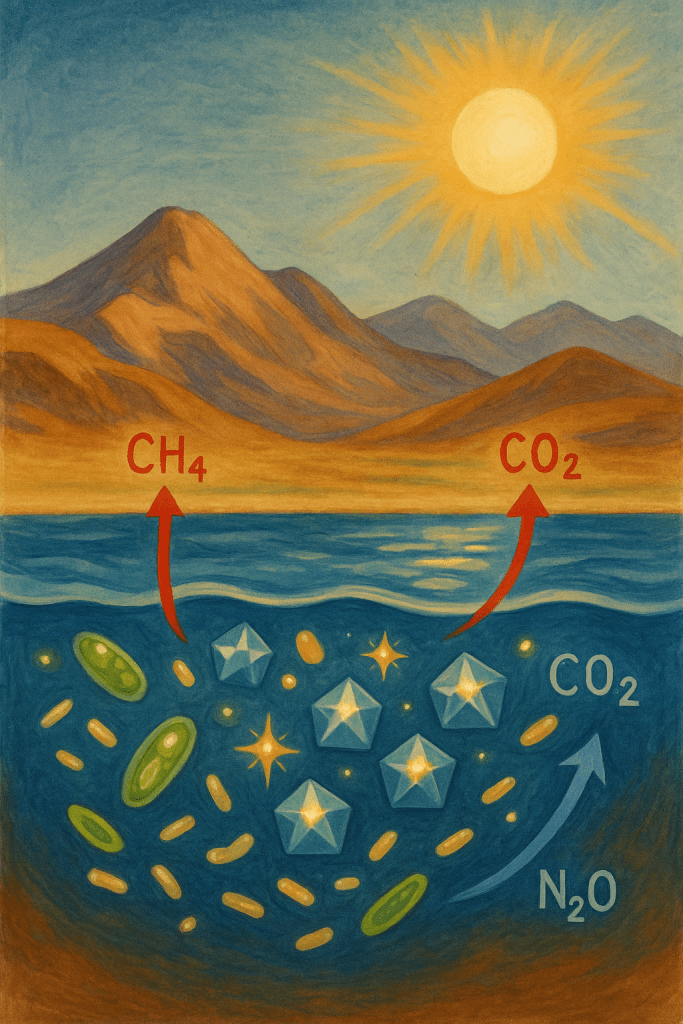
In the Salar de Huasco, under the high Andean sun, invisible viruses pulse with life.
They break cells, recycle nutrients, and feed the microbial loop.
Thus, they modulate Earth’s hidden cycles: releasing methane and carbon dioxide to the air,
while trapping nitrous oxide in the waters.
They are silent sentinels of climate change, crystalline guardians of planetary rhythms.
 la voz de los virus
Deja un comentario